What Is a Pocket Door? Everything You Need to Know
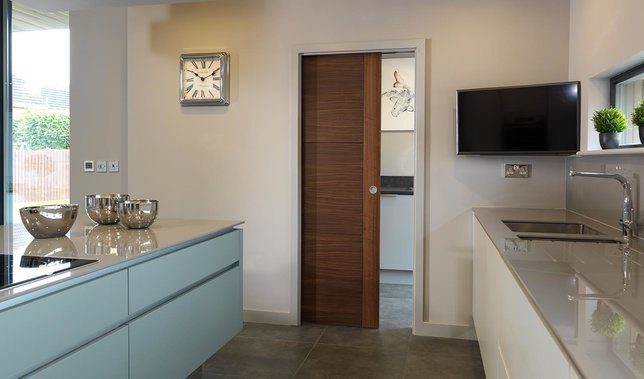
What is a pocket door?
A pocket door is a type of internal sliding door that, when fully open, slides completely into a recess – or ‘pocket’ – built within the wall cavity. Unlike a standard hinged door that swings into a room, a pocket door moves horizontally along a track and disappears from view inside the wall, freeing up floor space and improving flow between rooms.
Pocket doors are sometimes called pocket sliding doors or sliding pocket doors – the terms refer to the same system. What distinguishes a pocket door from other sliding door types is that the door retracts fully inside the wall rather than remaining visible on the surface.
How does a pocket door work?
A pocket door system consists of three main components: the door itself, a steel track fixed within the wall frame, and rollers attached to the top of the door that allow it to glide smoothly along the track. The wall cavity is built out using a steel-framed cassette that is fitted during construction or renovation – this is the ‘pocket’ the door slides into.
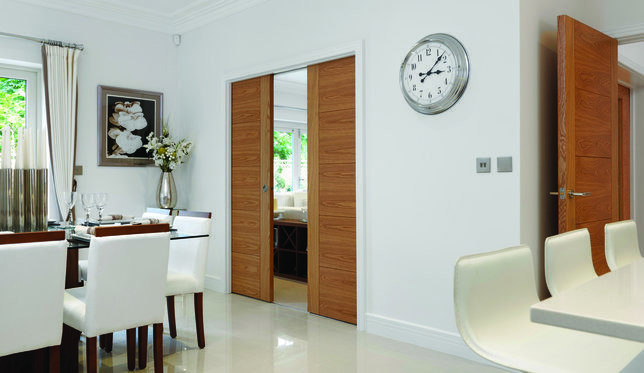
When you open the door, it slides horizontally on its rollers until it is completely enclosed within the wall. When you close it, it slides back out to cover the doorway. Single pocket doors operate from one side of the frame; double pocket doors slide in from either side and meet in the middle.
Pocket door system: key components
|
Component |
What it does |
|
Steel wall frame (cassette) |
Creates the pocket inside the wall cavity to house the door |
|
Track |
Fixed to the top of the cassette; the door hangs and rolls along this |
|
Rollers / door hangers |
Attached to the top of the door; allow smooth, quiet operation |
|
Floor guide |
A small channel at floor level that keeps the door aligned |
|
Door edge pull |
Recessed handle on the door edge, used to slide the door open and shut |
Pocket door meaning: where does the name come from?
The word ‘pocket’ refers to the hidden cavity within the wall that the door slides into when open. Just as a pocket conceals its contents, the wall pocket conceals the door entirely – leaving the doorway unobstructed and the room uncluttered. The term has been in use since the 1800s, when pocket doors were popular in Victorian townhouses and estates.
Why choose a pocket door? Key benefits
Pocket doors are consistently chosen for one practical reason above all others: they save space. A standard hinged door requires a clear swing arc of roughly 0.5–0.9 m² depending on size. A pocket door requires none. That recovered footprint is particularly valuable in:
- Smaller homes, flats, and studio apartments
- En suites and downstairs bathrooms where a swing door can block the basin or toilet
- Open-plan living areas where you want to divide or connect spaces without visual bulk
- Laundry rooms, larders, and utility spaces
- Fitted wardrobes and storage areas
Beyond space-saving, pocket doors offer architectural flexibility. Because virtually any door design can be adapted for use in a pocket system – glazed, solid, painted, or wood-veneered – there is no need to compromise on style to gain the practical benefit.
Are pocket doors stylish?
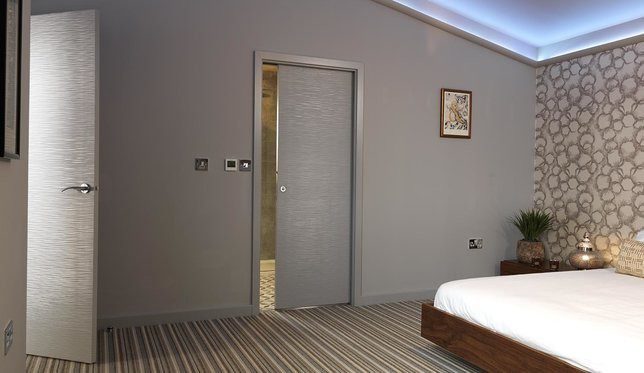
The notion that pocket doors are plain or utilitarian is outdated. At JB Kind, almost all door designs in the range are suitable for use as pocket doors – including glazed options, contemporary flush panels, and classically styled moulded doors. Whether the priority is a minimalist aesthetic or a traditional feel, there is a pocket door to match.
Glazed pocket doors are particularly popular in open-plan homes because they allow light to pass between rooms while maintaining acoustic separation. Contrary to a common misconception, glazed pocket doors do not require reinforced glass – all pre-glazed doors supplied by JB Kind comply with UK building regulations and use safety glass as standard.
What is a pocket door system in the UK?
A pocket door system is the complete hardware kit that enables a door to be installed as a pocket door. It includes the steel wall frame cassette, the top track, the door rollers, and a floor guide. Most systems are designed to be fitted during new build or renovation – the cassette replaces a section of standard stud wall, and standard plasterboard is applied over it to create a seamless finish.
JB Kind pocket door systems are available in a range of sizes to accommodate single or double doors. The systems are engineered for UK standard door dimensions and are compatible with the full JB Kind internal door range.
Pocket door detail: installation considerations
Pocket doors are best installed during a build or major renovation because the wall cavity needs to be opened up to fit the cassette. That said, they can be retro-fitted where the wall structure allows. Key installation details to consider include:
- Wall thickness: a standard pocket door cassette requires a minimum finished wall thickness of approximately 100 mm.
- Services: electrical cables, water pipes, or gas pipes running through the intended pocket wall must be rerouted before installation.
- Structural walls: pocket door cassettes should not be installed in load-bearing walls without appropriate structural support – always consult a structural engineer if unsure.
- Door weight: heavier doors (such as solid hardwood) require a heavy-duty track and roller system rated for the door’s weight.
- Soft-close: many modern pocket door systems include soft-close mechanisms for smooth, silent operation.
A brief history of pocket doors
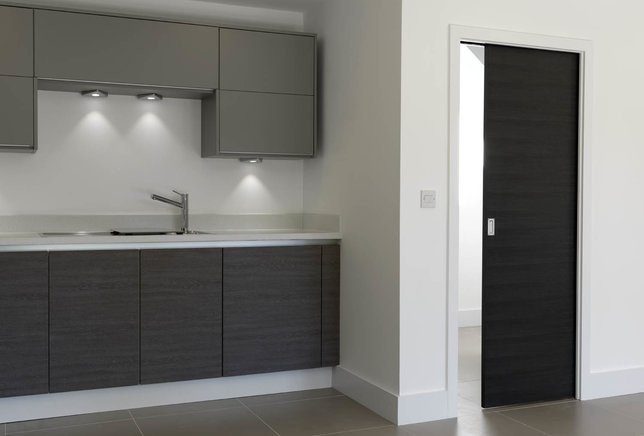
Pocket doors have been in use since at least the late 1800s, when they were a feature of Victorian and Edwardian townhouses – typically used to connect or divide formal reception rooms. Their popularity declined through much of the 20th century as building techniques simplified, but they have seen a marked revival in contemporary architecture and renovation projects, particularly in smaller urban properties where space efficiency is a priority.
Frequently asked questions about pocket doors
What is a sliding pocket door?
A sliding pocket door and a pocket door are the same thing – a door that slides horizontally into a wall cavity when opened, rather than swinging on hinges. The full name ‘sliding pocket door’ simply describes both the movement mechanism (sliding) and the way the door is stored (inside a pocket in the wall).
Are pocket doors suitable for all rooms?
Yes. Pocket doors are used throughout the home – bathrooms, kitchens, living rooms, bedrooms, utility rooms, and home offices. They are particularly well-suited to any room where a hinged door would restrict movement or furniture placement.
Can pocket doors be glazed?
Yes. Pocket doors can incorporate glass panels – including clear, frosted, etched, or bevelled glazing. There is no requirement for reinforced glass beyond the standard UK building regulation requirement that all pre-glazed doors use safety glass.
How much does a pocket door system cost in the UK?
Pocket door system costs vary depending on the size, spec, and door chosen. Hardware kits for a single door typically start from around £100–£200 for the cassette and track system, with the door purchased separately. Installation costs depend on the wall type and whether services need rerouting – budget for additional trades if required.
What is the difference between a pocket door and a barn door?
A pocket door slides into the wall cavity and is hidden from view when open. A barn door (also called a surface-mounted sliding door) slides along a track fixed to the wall surface and remains visible when open. Pocket doors provide a cleaner, more architectural finish; barn doors are easier to retrofit as they require no wall modification.